

Giving thanks for personal grace and support
Pictured above: The Rose Reading Room in the New York Public Library's Stephen A. Schwarzman Building,
I haven’t felt like writing as much the past few months and clammed up a bit. The world’s been burning extra fiery and hot lately, so taking it all in can be a bit creatively stultifying. Thankfully, some personal grace kicked in and I let my writing meet myself where I am.
So, this here missive, after a long hiatus, represents what I’ve been reading, seeing, watching or making lately. Take a look at some recent artwork, watch an orchestra play Fat Boy Slim hits, apply to speak at a design conference, and grab some interesting reading to last you through the long weekend. Let’s explore, shall we?
Also: Where have you been giving yourself some grace lately? What or who have been supportive in your world? Hit reply and drop me a line. I’m especially interested in the concept of giving oneself the pause and space to think in order to move forward. Stopping in order to move forward, paradoxically.
Current Exhibition | “Haneen – a journey of yearning, nostalgia and myth making”
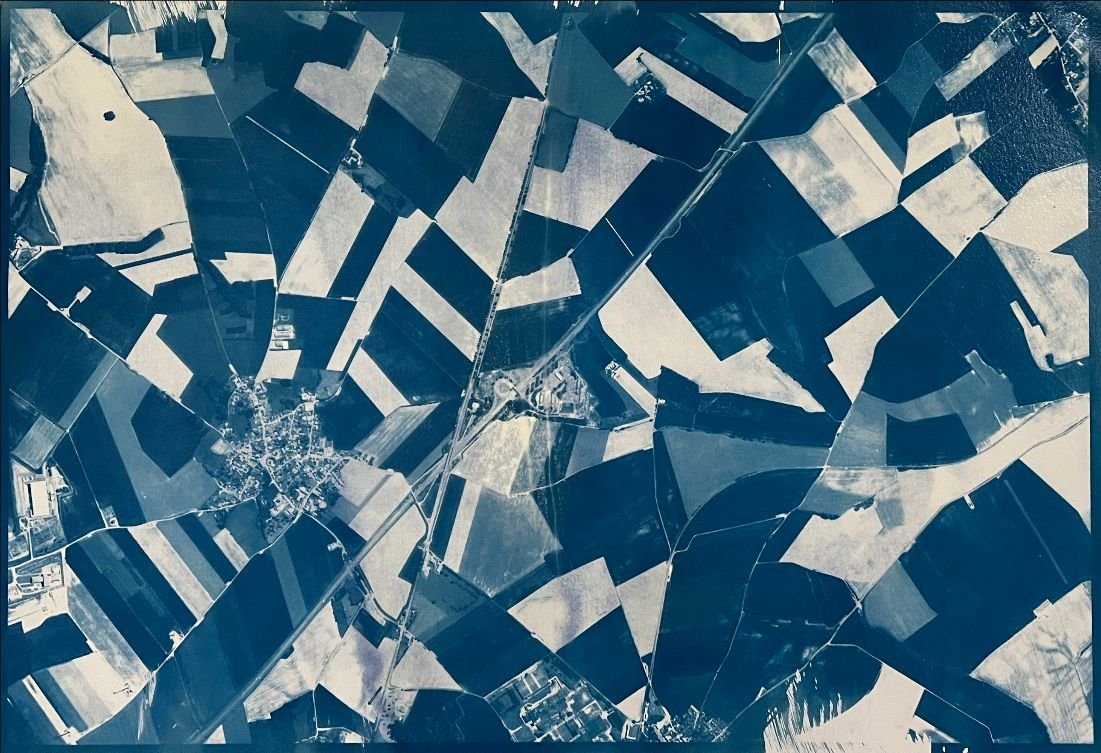
Le Relais (The Rest Stop), Urvillers, Picardy, France (49.785217° N, 3.335063° E) | Cyanotype print
Over the past year and especially the last couple months I’ve been slowly developing an art practice again after 20+ years of being away. I’ve been particularly experimenting with the concepts of (im)migration, the interstitial (being between places/states), and trying to find a sense of place overall.
The media I use are cyanotypes of satellite maps along with colour giclée photographic prints. For the next few months, I’m in a collaborative exhibition with Palestinian-Scottish artist Leena Nammari and that of local printmakers. The official title is “Haneen – a journey of yearning, nostalgia and myth making”. We tackle the concepts of geographic displacement and its possible effects on current, past or future generations, culturally.
See some of my work here and on Instagram . I can’t wait to make even more instances and explore these concepts more deeply in the future.
Exhibition Info | Open:Nov 18th, 2023 – Feb 3rd, 2024 at the Gracefield Arts Centre, Scotland
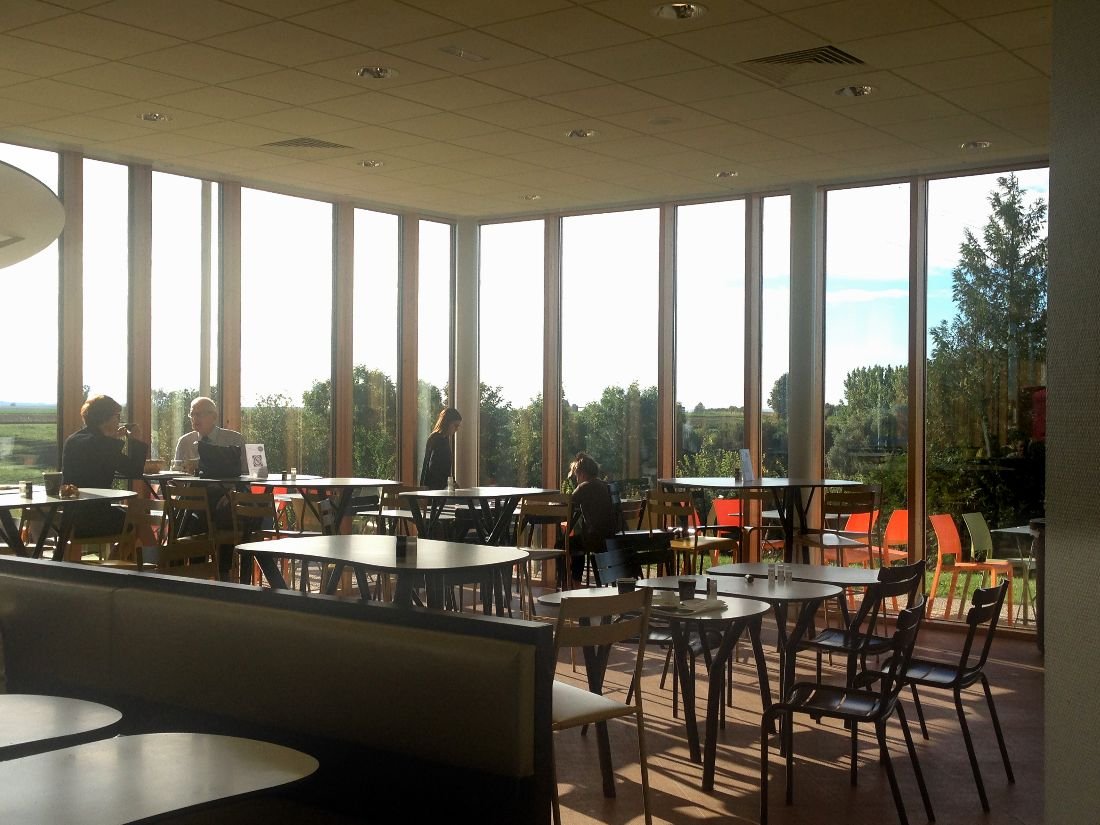
Le Relais, Interior| | Colour giclée print
UX Scotland 2024 Call for Speakers | 29-31 May 2024
Applications are due Friday, January 12, 2024
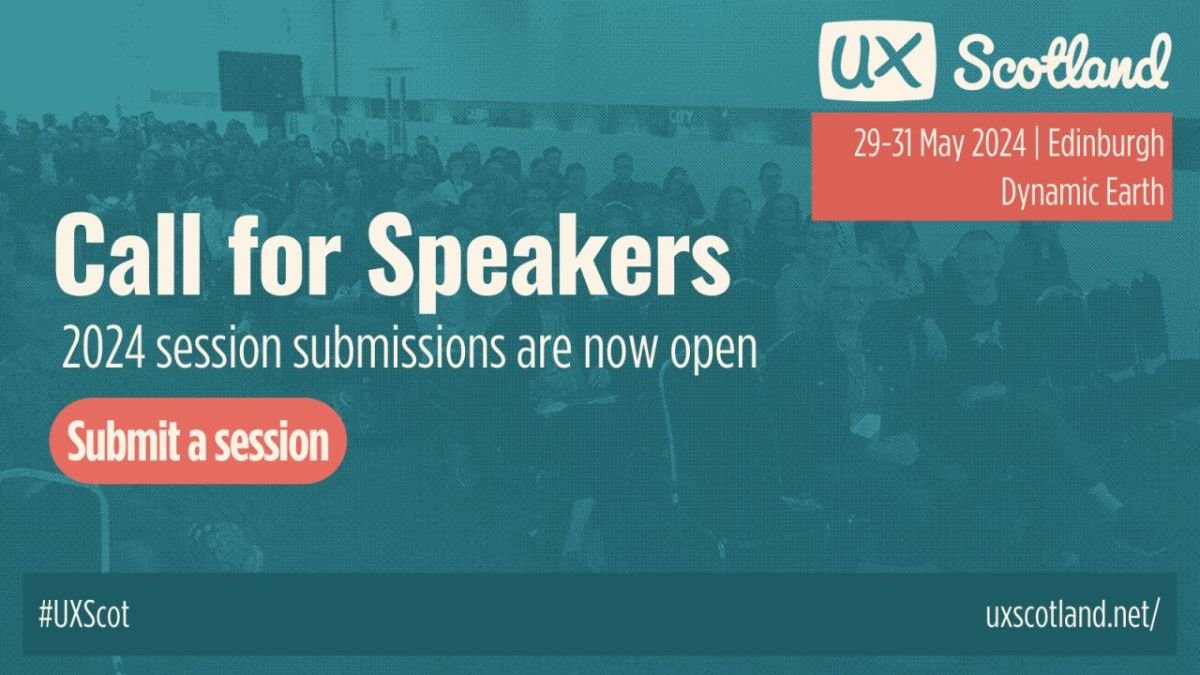
UX Scotland is putting out its call for speakers for the 2024 edition. It’s a great group of service designers, ux designers and researchers, and others involved in user-centered design. You don’t have to be a resident of the UK to apply to be a speaker. If you have an idea for a workshop, talk, case study or whatnot, just bring it. Applications are due Friday, January 12, 2024.
I’m also proud to say I’m now part of the advisory panel for UX Scotland who will craft the conference along with the vital attendee feedback received each year.
Apply to speak at UX Scotland| Need some guidance?Check out some quick tips
Links 'n Tings
In my recent mental and visual periphery.
READ

Wintering: The Power of Rest and Retreat in Difficult Times by Katherine May
A look at myriad ways we can navigate various seasons of life and the year, sink deeply into them, and acclimate ourselves to our surroundings. I've been chipping at this book for the last year at a nice slow pace.

"While amusing to see the homogenization of content writing, this actually points to a real problem: a lack of understanding of context."

Originally written by Octavia Butler in the 1979, in 2017 it was adapted by John Jennings and Damian Duffy into a graphic novel. Kindred follows a Black woman in the 1970s who's ripped back into plantation slavery via unwilling time travel. I honestly hadn't read the book up until now and it took seeing it visually formatted to finally help me devour the story.
WATCH OR LISTEN

Listen to all your favourite dance hits played by an exceptionally happy classical orchestra. Watch and smile for a couple hours.
SEE OR DO

and its new looks for the season. Created by Margaux Rusita, a designer originally from Guyana who now lives in Burundi. She designs and crafts jewelry based on Amazonian low-waste values and East African materials. Site link

"This online exhibition is about our families, whether chosen, by blood or by proximity. These human stories, memories, and histories comprise the past, present, and future of lives lived and projections of what may be."
Artist: Anahit Cass
Thank you for reading…
As I mentioned at the beginning: Where have you been giving yourself some grace lately? Just reply and ping me. If you'd like to chat sometime in the next couple months, schedule some time in my calendar for a catch up. The holiday season is packed so let's give ourselves some realistic timelines. :)
In the meantime, go find me around the web as well:
Website | LinkedIn | Medium | Twitter | Instagram
Talk soon,
Tricia
Going back to Africa + how do you find your fit? (April 2023)
Going back to Africa + how do you find your fit? (April 2023 Newsletter)
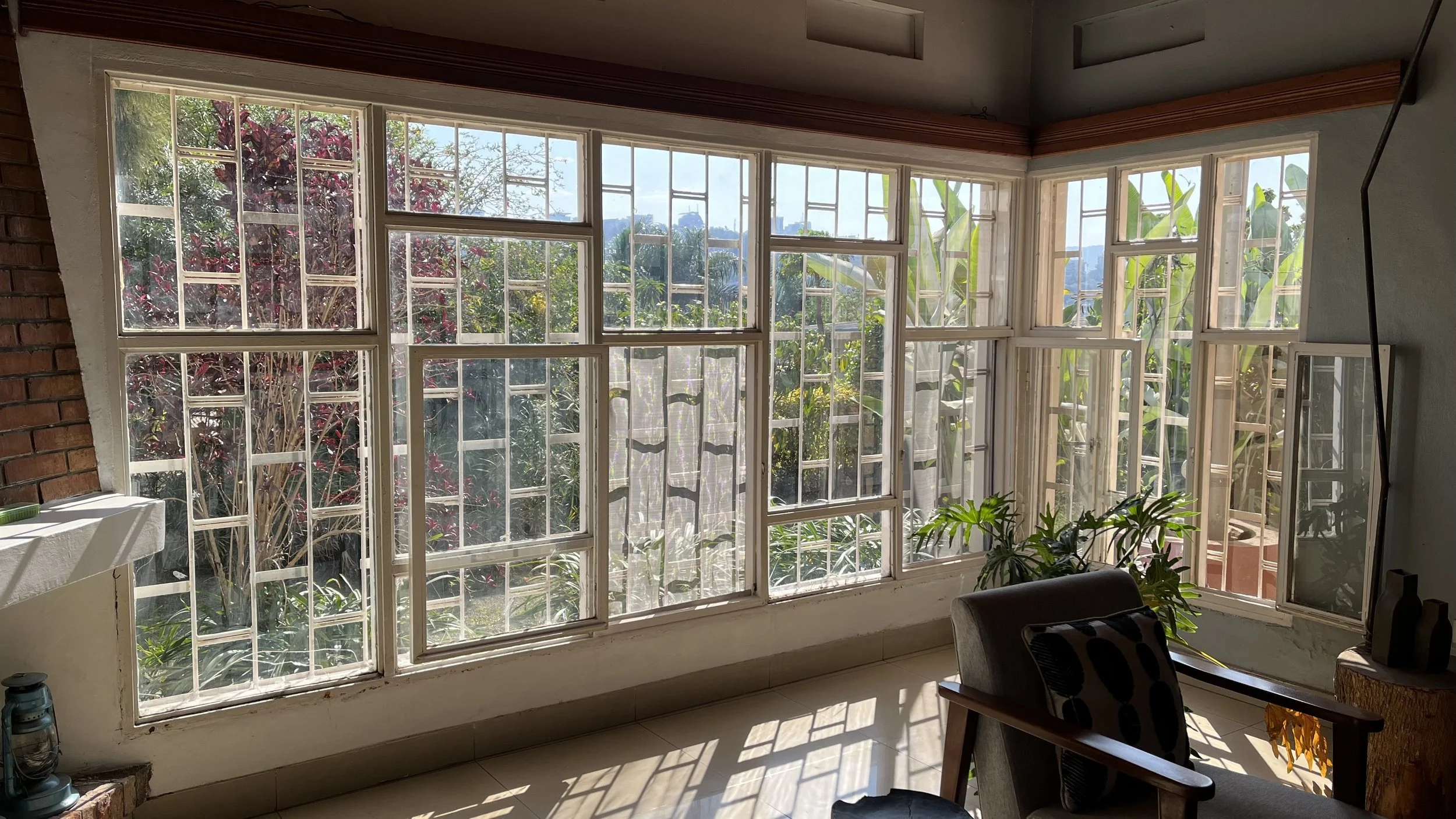
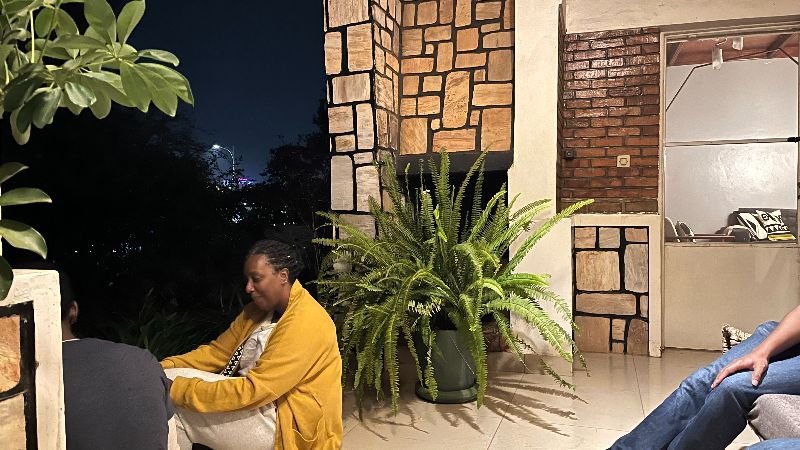
Pictured above: Our friend's house in Kigali, Rwanda. A beautiful example of modern African design and decoration. See more photos on Instagram.
Welcome to April. I’ve had a gentle start to the new year and have some good things that happened in 2022 and even the beginning of this year that I wanted to share with you. Last year I took some amazing trips, primarily a 2 week trip to Kenya and Rwanda last summer. There are a couple conferences on my radar including UX Scotland, where I’ll be speaking later in June 2023.
What’s new with you? What good things are you open to sharing? What workshops or conferences are you attending?
BTW: My work calendar is opening up around June this year. Lately I've been working on healthcare, startup innovation, and non-profit projects. If you're looking for some service design, UX design/research, and design innovation collaboration, I'm your woman. Just hit reply to this email or click tricia@triciaokin.com and we can start having a convo.
Back to Africa – Kenya & Rwanda, specifically
The African sun on my skin was healing.
Overlooking the Kilimani neighbourhood of Nairobi, Kenya
Last July I had the opportunity to visit Rwanda and Kenya for the first time with the invitation and guidance of friends who live there and visit regularly. Going to Rwanda and Kenya was one of the biggest things that has happened to me in years.
If you possibly listened to my podcast interview I gave February 2022, you would’ve heard that the last time I was in Africa was the age of five, when my family fled the coup in Nigeria at the time. Packing our bags and driving through a military checkpoint at night, I woke up in Spain and then in New York City. Counting on multiple fingers, that means I hadn't stepped foot in Africa for 37 years.
Being in Nairobi, Kenya and Kigali, Rwanda was such an interesting feeling. It surprised me how much and quickly I adjusted to being back in Africa and felt somewhat healing to be in the majority again. The colours, temperatures, food, and people didn't hurt either. I've posted a few images on Instagram and will add more over the coming weeks. (Teaser: there may or not be a in giraffe in there somewhere.)
Speaking at UX Scotland, June 7–9, 2023
Come join the discussion about finding your fit.

This June, I am so proud to be speaking at UX Scotland in Edinburgh. My session will delve into understanding which kind of teams work for you, how to express your needs and listen to others create a good working environment. Come join me – Get In Where You Fit In: Understanding Which Teams Work For You on June 8th, 3:30pm – 4:15pm GMT.
Buy tickets now at https://uxscotland.net/tickets and use the Promo Code:10Tricia for 10% off any ticket purchase.
Also, have a read of the article I wrote about how much I enjoyed the conference the last time I attended pre-pandemic. Overall, UX Scotland is a friendly conference with quality speakers and a good vibe overall.
QUESTION! What were some noticeable indicators about how well or poorly you worked in a team? Just email me at tricia (at) triciaokin.com and jot down a couple sentences.
Focusmate Round Up
Around the world, around the world...
You’ve all heard/read me yammer on about Focusmate last year, as the virtual coworking service I use to get things done in various parts of my life. Early in January they sent us users our individual 2022 totals. Call me blown away. Here are my stats:
22,325 Focused Minutes ( ≈ 372 hours)
210 partners spread over 37 countries.
Really, this virtual coworking thing has been a life saver for me. I've even made friends with some of my Focusmates and am going to meet up with them later this year. Whether I’m making art, working on client projects, writing this newsletter, meal prepping or even cleaning, it’s been a big help.
Find out more at http://focusmate.com. (I swear I'm not getting paid for this, I just love the damn thing.)

Travel 'n Tings
Where I'll be on this blue orb over the next couple months.
April 12 – 18, 2023: London
I'll be visiting friends, soaking up art, getting an injection of urban concrete and eating ALL THE THINGS. Hit me up for lunch or coffee if you'd like to meet up and chat.

May 4 – 9, 2023: Munich, Germany
That weekend is the Design Drives Conference focused on design innovation and strategy, which I will happily be attending. I'm also slipping in a side visit to Nuremberg to see a German art friend as well. Again, if you're close by or attending, let's connect.

June 5–12, 2023: Edinburgh, Scotland
The first couple days will be heads down prepping for UX Scotland but after that I'm free as a bird to hang out!

June 13 – July 14, 2023: 🗣️BROOKLYN!
I'm so excited to be back in my NYC home over the summer for a whole entire month. Definitely roll up if you'll be in town and let's hang out

That's April in the bag...
Thanks so much reading this little peek into what's going on over here. It's an attempt to stay connected with people I've known, met and worked with for years and decades and I love hearing from you. What's up with you and how are you staying connected to/in your personal and professional lives? Let me know and schedule some time in my calendar for a catch up. Next month, Links 'n Tings will return with some good links that have been floating around my note.
In the meantime, go find me around the web as well:
Website | LinkedIn | Medium | Twitter | Instagram
Have a lovely holiday weekend and talk soon
Tricia
What if your scarf can track your emotions? (November 2022 Newsletter)
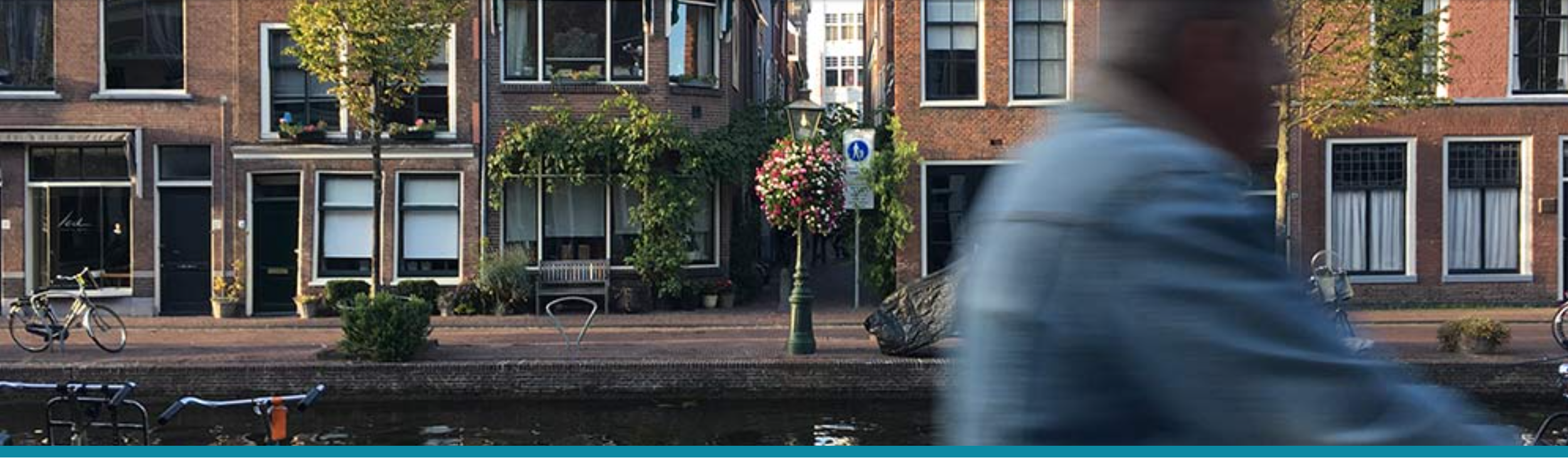
Pictured above: A canal in Leiden, Netherlands.
Pictured above: A canal in Leiden, Netherlands.
Hey, it's been a minute. This summer swept by and now it's settling cozily into autumn over here. Listen, I'm trying to put a positive spin on the ever darkening afternoons for the next few months. Because summer was fun, I'm still collecting my thoughts and photos to share at a later point. Thus, this newsletter is going to be a bit of a round up of articles and stories I've been reading over the past few months and wanted to share with you.
Looking ahead to 2023, if you're planning projects around designing new systems or web sites, design innovation, communities, healthcare, education or other expansive ideas, hit me up. I'd be glad to discuss collaborating. Just hit reply to this email or send an email to tricia@triciaokin.com.
Now on to the bevy of articles talking about reconnecting Indian & Pakistani elders to their homelands via VR, glasses made for Black features, a nosy smart scarf, and music based on COVID's genetic code. Let's tuck in, shall we.
Links 'n Tings
A few articles, items, and tings that piqued my interest recently.
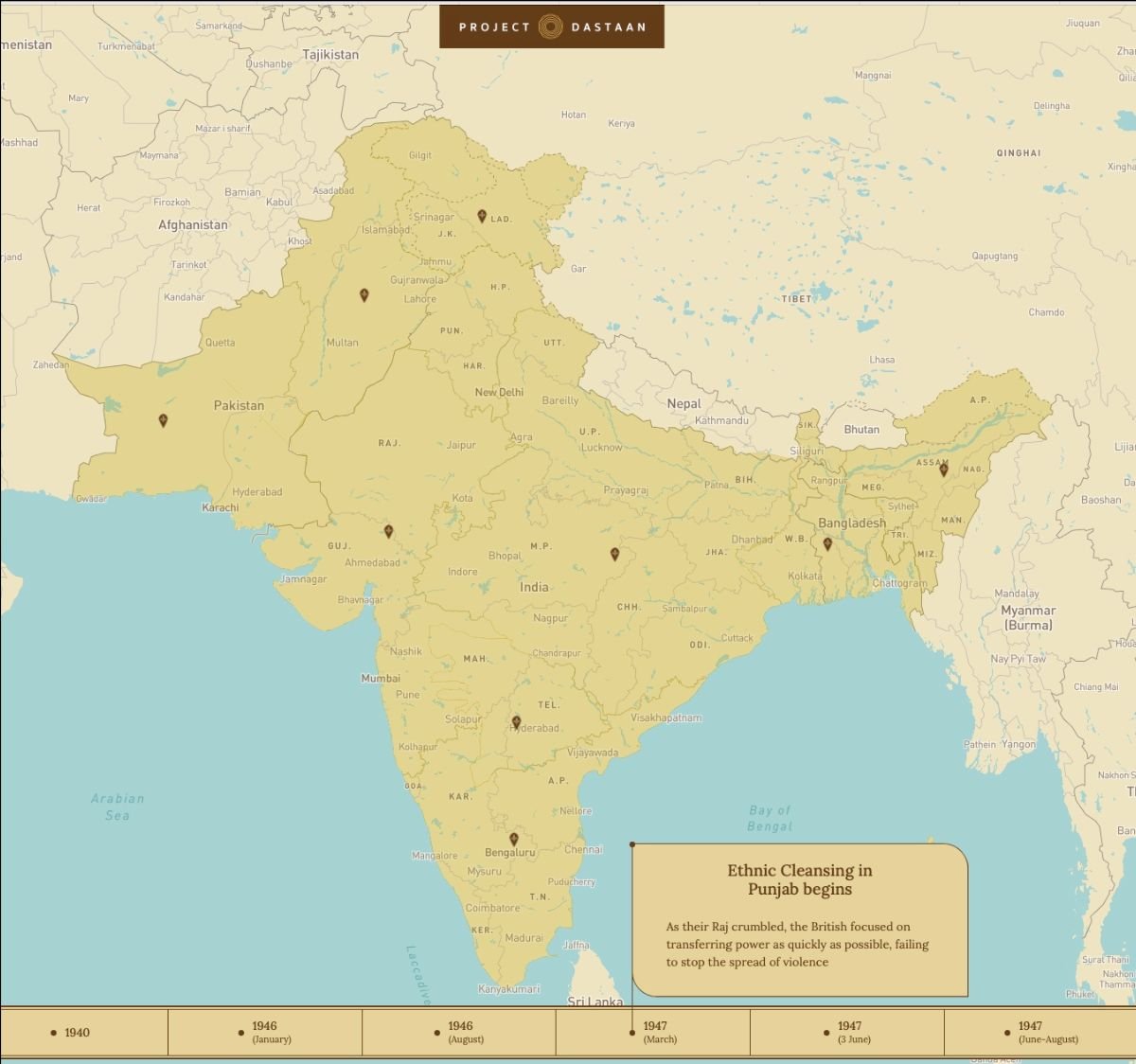
Project Dastaan Helps Survivors of India & Pakistan’s Violent 1947 Partition Revisit Their Homelands Using VR
From NPR: Ishar Das Arora, 83, watches a 3-D video of his birthplace in Pakistan, through a virtual reality device. Raksha Kumar/NPR
Earlier this summer, it was the 75th anniversary of India and Pakistan's extremely violent partition of the two countries by the British government. The act cleaved the former large colony into the two countries we have today. So many people were lost, killed, and displaced. Millions have never been able to "go home" to visit their birth areas since then.
Project Dastaan ("story" in several South Asian languages), is a documentary project that delivers immersive video experiences to survivors of the 1947 Partition of British-ruled India into independent India and Pakistan. I originally heard about it on NPR and it truly made me tear up listening to the elders experiencing their homes for the first time in decades.
Kimeze: Luxury Eyewear Brand Catering Specifically to Black Facial Features
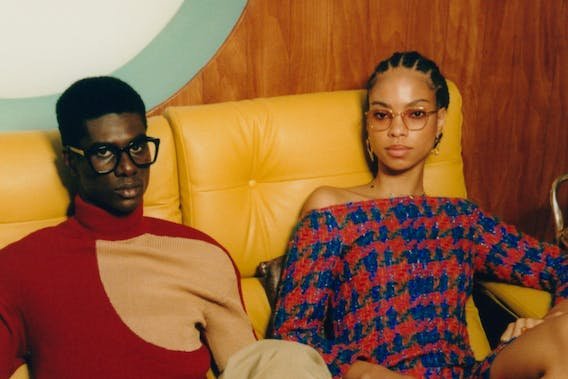
The brand, founded by sisters Clare and Christina Kimeze, is revolutionising the eyewear industry by creating frames to fit Black and brown nose bridges after noticing a gap in the market.
Okay, so reading this article made me question all of my glasses wearing experience for the last 35 years of my life. Why have they always never fit my nose bridge? I mean, since I was 6 years old all the way up to 42 now. The glasses I'm wearing right now while writing are constantly sliding down my face even after a "good" fitting.
It turns out that most glasses and sunglasses are deliberately designed for Caucasian and Asian features – and this is widely known within the industry.
Manchester City Football Club is Testing Smart Scarves That Collect Fan Data
England's Manchester City soccer club wants to know how its fans really feel, and it has gone so far as to pilot The Connected Scarf, a "smart scarf" stuffed with sensors that the organization says enables it to gauge fan emotions.
"The scarf records a range of physiological measures, including heart rate, body temperature, and emotional arousal—giving us concrete information to analyze how fans are feeling at different moments in the match," the page says.
This feels like a dystopian collaboration between wearable technology, sports, and advertising. They're planning to serve up "curated, customized experiences" during the match. Maybe if you're anxious they'll send messages to your watch or phone to order beers or food? Who knows but it feels like a bit of a stretch and like it doesn't exactly benefit the wearer / sports fan.
COVID's Genetic Code Interpreted Into Music
Mark Temple, both a medical molecular biologist and an indie rock musician, became curious during the pandemic and began converting Covid's DNA sequences into notes, allowing him to recognize unseen patterns in their sequences. Check out this article to listen to sonifications of a coronavirus spike protein, of protein folding, and of the thyroid hormone!
Listen on The Smithsonian Magazine | Mark Temple’s YouTube channel
That's it for now!
The year's winding down and the dark is closing in. What do you think of the articles and do you have any cool news to share? Let me know. Schedule some time in my calendar for a catch up.
Go find me around the web as well:
Website | LinkedIn | Medium | Twitter | Instagram
Have a lovely week and talk soon,
Tricia

The state of SMS marketing, spinach that can send you emails, and James Dean. (May 2022 Newsletter)
The state of SMS marketing, spinach that can send you emails, and James Dean. (May 2022 Newsletter:)
THANKS FOR STOPPING BY!
This content is from my May 2022 Newsletter. If you’d like to sign up to receive my monthly(ish) newsletter, here’s the link. If you'd like to look at the archive, here’s the campaign URL.

Howdy and welcome to (the near end of) May. It's been a mix of rainy but absolutely beautiful and blooming here over in Scotland. How are nature and people showing up around your way?
A wee bit of housekeeping... email change!
I’m switching over to the email address tricia@triciaokin.com going forward. Over the next few months I’ll deprecate my old tricia@papercutny.com account. I've had the latter email address for more than 15 years and I've found it's time to retire it. Update your address book!
On to the stories. There are some links about SMS marketing, spinach emailing, and James Dean. It's a wide variety y'all.
The State of Conversational Commerce in 2022

This is a good visual report on how people are interacting with brands via SMS. I’m a complete “NO SMS MARKETING PLEASE” person so some of these stats surprised me and were a good wake up call. Over 63% of people had clicked a brand’s link in an SMS message to purchase something within the last 3 months. Holy crap!
Read the full report
Scientist Have Create Spinach That Can Send Emails (and Fight Climate Change)

Okay, this is from last year but why didn’t y’all tell me about this?? So spinach won’t be forwarding you chain emails but the scientists “have engineered spinach plants that can detect explosive material in soil and relay information back via email.”
That feels better. De-mining the earth and sending emergency messages about changes in climate and temperature is much better use of plants’ work time than memes.
45 Vintage Photographs of James Dean

Dennis Stock was a young Magnum-certified photographer when he embarked on the assignment of documenting several months in James Dean’s life in 1955. Stock followed Dean around New York, on the set of Rebel Without a Cause, and on to his family’s farm in his hometown of Fairmount, Indiana playing with his little cousin Markie. Revel in the lush black and white photographs, the contrast, and the lowered personal guards of James Dean. I definitely did.
Flip through all 45 photographs


Podcast guesting, fake design agencies & Tetris (March 2022 Newsletter)
Each month(ish) I send out a newsletter around design, innovation, art or just what piques my interest.
Thanks for stopping by!
This content is from my March 2022 Newsletter. If you’d like to sign up to receive my monthly(ish) newsletter, here’s the link. If you'd like to look at the archive, here’s the campaign URL.

Pictured above: Inside the Fondation Louis Vuitton, Paris in October 2021. View the full photo on Instagram
In this edition, I'm happy to share my first time as a podcast interview guest and various links that resonated with me this month including stories about fake design agencies and Al Roker's previous short stint as a cartoonist. Let's dig in.
Nowhere is Perfect: Guest on The Reset Podcast
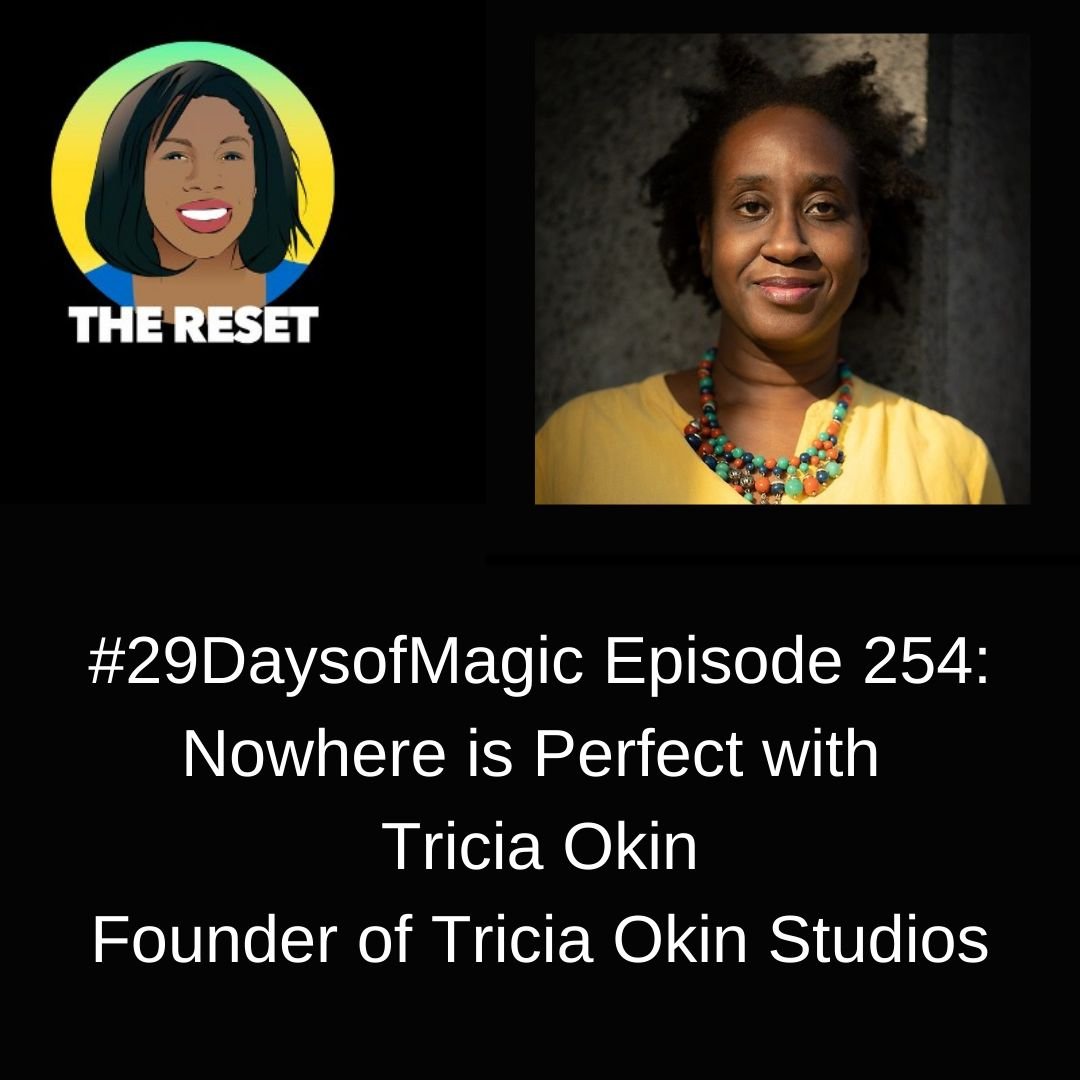
Every February, my friend and colleague Laura Mignott does a 28 (or 29) Days of Magic podcast series where she interviews a different Black woman a day about their career paths to commemorate Black History Month. After 2 years of us wrangling schedules, we finally sat down last week to dish.
Listen in to my conversation with Laura Mignott on The Reset Podcast: #29DaysOfMagic. On it we explore my career journey and my path to design. I talk about my time living in and around Western Europe where I noticed when people realize that I'm an African American, they treat me much differently than before when thinking that I was just from Africa. Laura and I touch on my family escaping a coup in Nigeria, becoming an artist again, and we take a deeper dive into thoughts on inclusivity, empathy and much more.
Click below to listen or wherever you listen to podcasts.
Madbird: The Fake Design Agency

Madbird created an elaborate con that tricked dozens into working for a fake design agency.
Most of the 40 people on the all-hands Zoom call were fake with the exception of a few real employees. Fake LinkedIn profiles, company email addresses, everything. The whole thing was fake - the real employees had been "jobfished". The perpetrator and design agency “founder”, Ali Ayad, is an inspirational Instagram influencer.
The BBC spent a year investigating what happened.
Using Travel Posters to Tackle Anti-Asian Hate Crime

“Where are you really from?” I’m sure some of my readers have had that question asked of them or at least heard it in the ether. It sucks when people question your identity.
In order to address this, some folks in the AAPI community teamed up with the AA Federation, community members, and designers of Asian American backgrounds to create travel posters for the cities they’re really from. One of my favourites is for Seattle by Bianca Austria.
View all the posters and the campaign | Check out more of Bianca’s gorgeous illustration work
h/t Creative Review
Interview with Tetris' Creator

I remember playing Tetris for the first time maybe in early/mid 90s in 7th grade “Computer Class”. Mind you, this was after playing Oregon Trail at 6 years old in school with large 5” floppy disks. When did you first play Tetris?
In 1984 Tetris, one of the most popular computer games ever, was invented in Moscow by a bored research scientist who wasn't challenged enough in his job. In this 9 min interview, BBC reporter Chloe Hadjimatheou spoke to its creator, Alexey Pajitnov, and to Henk Rogers, an American businessman who helped bring Tetris to the world.
Did You Know Al Roker Was a Cartoonist for the Syracuse New Times?
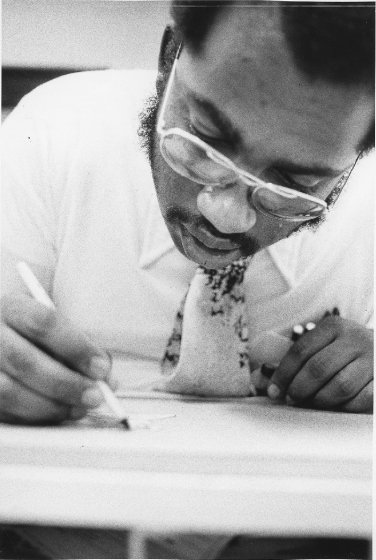
How cool is that? Turns out America’s favourite weatherman had a short lived career as a cartoonist while finishing his degree at SUNY Oswego way back in the day. His comic strip called “Salt & Pepper” debuted in 1976 in the now defunct Syracuse New Times and featured a political Doonesbury-esque theme of taking jabs at local Syracuse politicians and community leaders.
Its main characters were two roommates Gregory Salt (a visual alter ego for Al Roker himself) and his White roommate McFarland W. Pepper. The strip only lasted 10 weeks before Roker got a job in a Washington DC TV station and properly launched his meteorology career.
Below is one of Roker’s very mid-70s comic strips including a Ralph Nader reference. Read the other comic strips if you want a hyperlocal politics flashback.

Another one in the bag, y'all.
Going forward, I'd love to share more links to interesting items I've found around the web. What did you think of this edition? Also, please share any cool newsletters you're subscribed to currently. Email newsletters and their design are something I'm geeking out on right now.
Also, just a quick note. There was a lot of wonderful response from January's email around the Writers' Hour. So many people reached out about it being a helpful tool and it passed it on to others. I'm so happy it was a useful resource for so many people.
Want to swap resources or team up on projects? Drop me a line. Schedule some time in my calendar for a quick chat.
Go find me around the web as well:
Website | LinkedIn | Medium | Twitter | Instagram
Have a good week y'all,
Tricia

The Reset Podcast: #29DaysOfMagic
Every February, my friend and colleague Laura Mignott does a 28 (or 29) Days of Magic podcast series where she interviews a different Black woman a day about their career paths to commemorate Black History Month. After 2 years of us wrangling schedules, we finally sat down last week to dish.
Listen in to my conversation with Laura Mignott on The Reset Podcast: #29DaysOfMagic. On it we explore my career journey and my path to design. I talk about my time living in and around Western Europe where I noticed when people realize that I'm an African American, they treat me much differently than before when thinking that I was just from Africa. Laura and I touch on my family escaping a coup in Nigeria, becoming an artist again, and we take a deeper dive into thoughts on inclusivity, empathy and much more.
Listen below or wherever you listen to podcasts.
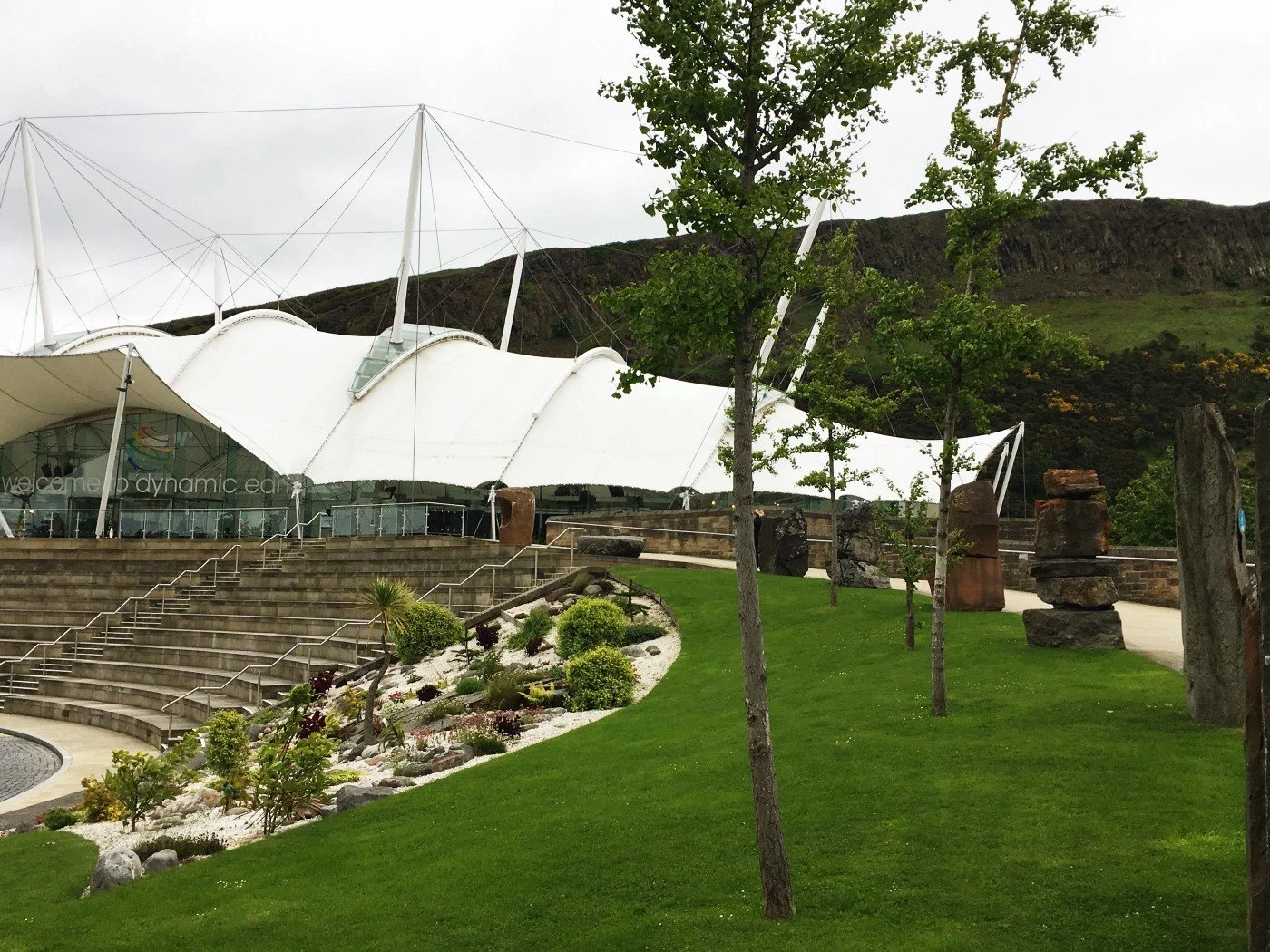
Impressions of a First Timer at UX Scotland
While trawling the internet for lists of design conferences late last year I stumbled upon the UX Scotland conference in Edinburgh. Through luck, I was going to be in town and the program looked like an excellent opportunity to dive into discussions about current practice. Here are some sessions that still resonate with me a couple of weeks after attending UX Scotland.
This was originally published in 2019 on Medium and has been updated with changed links as well as links to video talks.
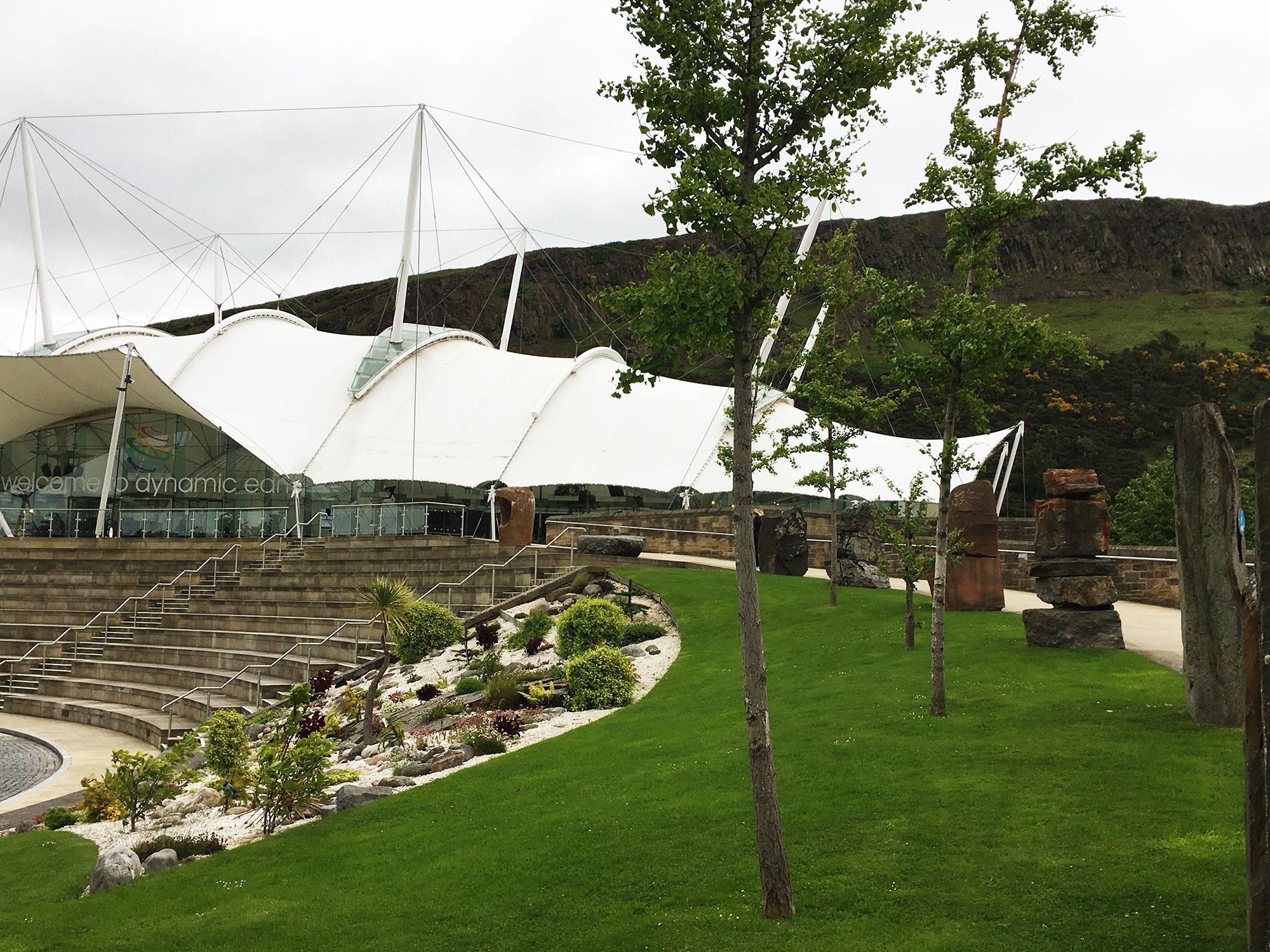
Dynamic Earth, the venue for UX Scotland in Edinburgh
While trawling the internet for lists of design conferences late last year I stumbled upon the UX Scotland conference in Edinburgh. Through luck, I was going to be in town and the program looked like an excellent opportunity to dive into discussions about current practice. Here are some sessions that still resonate with me a couple of weeks after attending UX Scotland.
Day 1 Keynote – Opti-pessimism: Design, AI, and Our Uncertain Future
Keynote Speaker: Cheryl Platz, Principal Designer and Owner, Ideaplatz —@funnygodmother
Cheryl Platz kicked off Day 1 with some good storytelling involving escaping an elephant while on safari. The core takeaway from Platz’s session is to truly design for humans: embrace optimism but understand that pessimism and edge cases are powerful tools to evaluate the veracity of one’s ideas.
User experience design and research used to focus solely on the “happy path” but we’ve not fully taken onboard the consequences of unchecked optimism and not looking underneath all the rocks. We’ve all seen what happens when scientists never assume their inventions will turn against them, but they (and we) just keep plowing ahead like nothing will ever go awry.
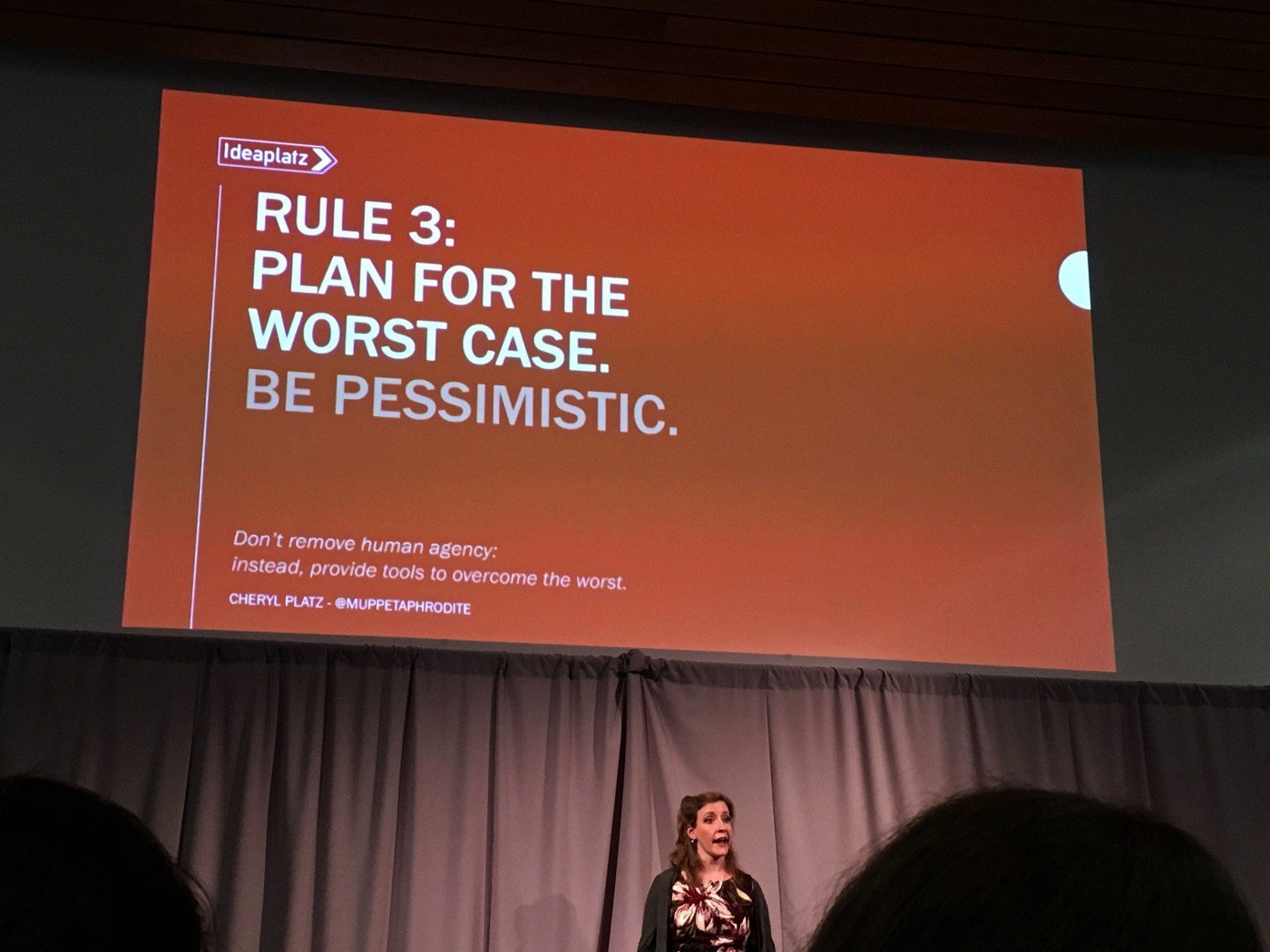
Hope for the best, plan for the worst case scenario. Slide © Cheryl Platz
By accounting for a multitude of people normally outside the project scope, bad actors, and other external factors over which we may not have control, we can future-proof design solutions a little bit more. This isn’t all just pessimism though. Platz asks the question, what if your users actually really love your product and it’s enormously successful? Have you considered how it will scale, how you can support the experience and build elasticity into the customer life cycle?
This talk was oddly comforting as I seem to be a natural born pessimist and can lean towards designing for “edge cases” regularly.
Why the quotation marks? As a person who’s a member of underrepresented groups in tech and in the places where these conversations take place, I tend to design with “others” in mind naturally. I can’t cover everybody but I ask “What if?” on a regular basis.
Have a look at Cheryl Platz’s slides and download them here. She also recently wrote an article on Medium expounding on the concept. Watch the video on Vimeo.
Machine Learning for Designers
Speaker: Memi Beltrame, Less A Mess — @bratwurstkomet
Without knowing it, I was actually chatting at lunch with Beltrame before his session saying how much I was looking forward to sitting in on it. Unsurprisingly, Beltrame’s session was illuminating, technical, and informative without being an onslaught of information. He comprehensively explained the difference between AI and Machine Learning (ML); the patterns used to train AI in image and language recognition; and he finished by posing some key ethical questions.
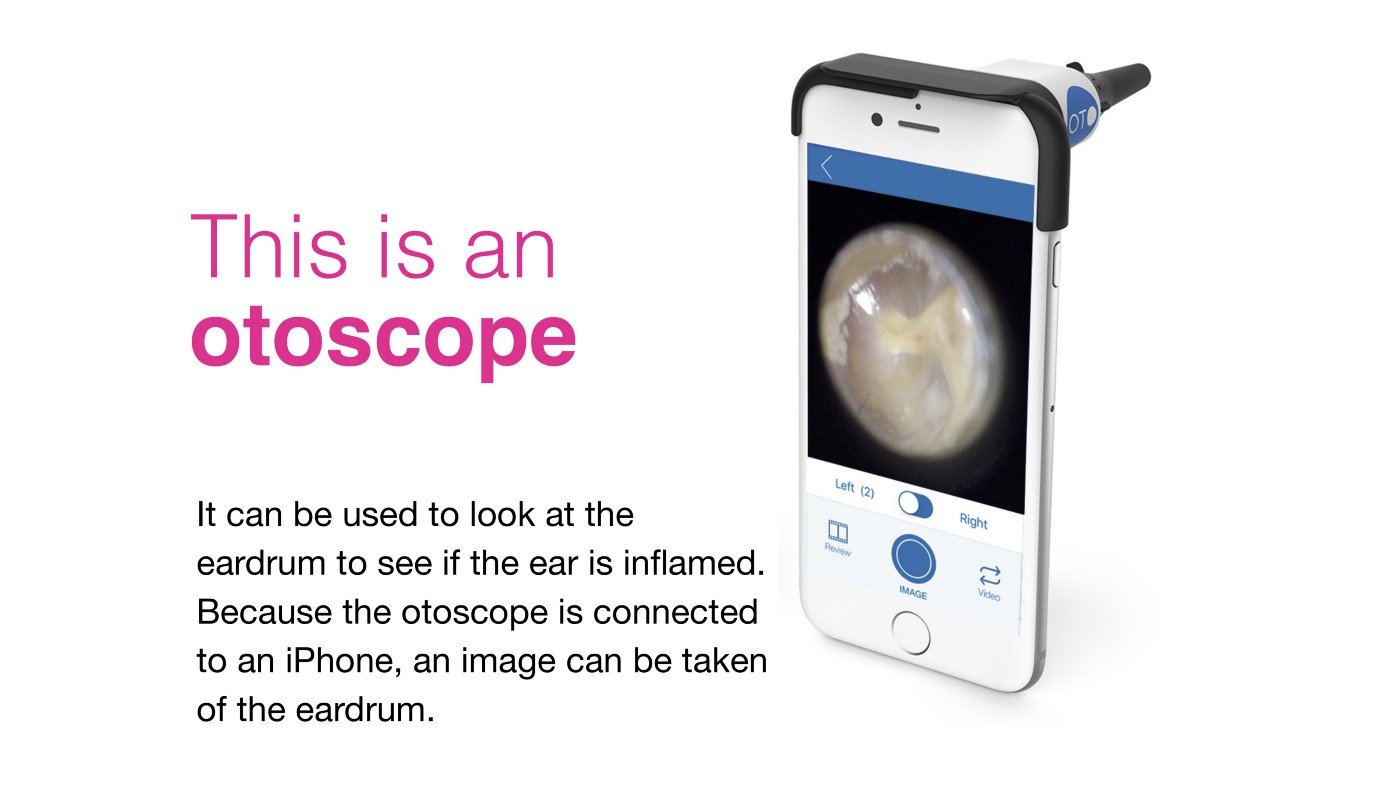
Combining app + medical device to create a new version of an otoscope. Slide © Memi Beltrame
Straight off the bat, he described where AI integrates into the loop of service design by using the example of a medical app used in conjunction with a small device that attaches to mobile phones. Together along with other digital components, creates an otoscope — a device to diagnose inner ear illnesses.

Service design loop for a physical object and a digital interaction. Slide © Memi Beltrame
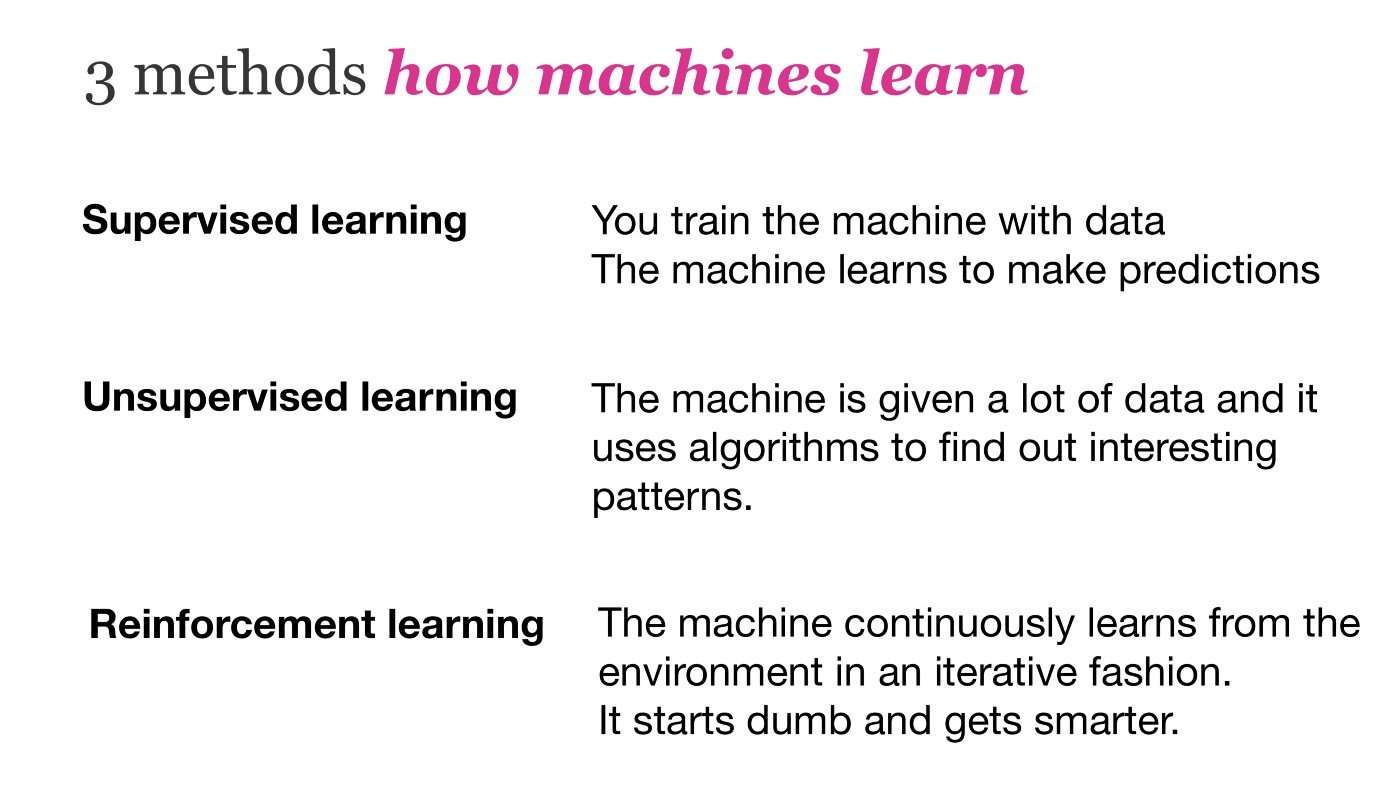
The 3 methods of training machines to learrn. Slide © Memi Beltrame
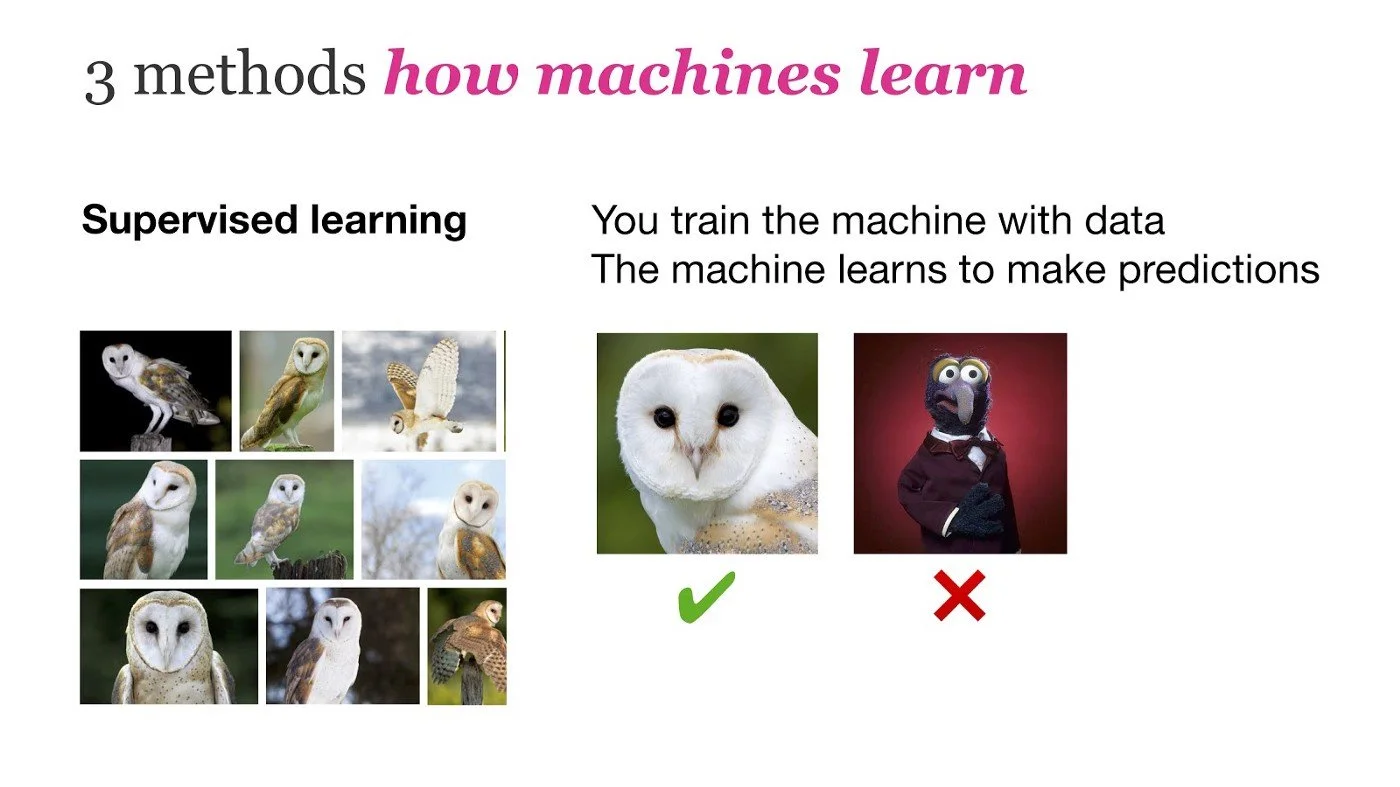
Is Gonzo an owl? Most likely not. Slide © Memi Beltrame
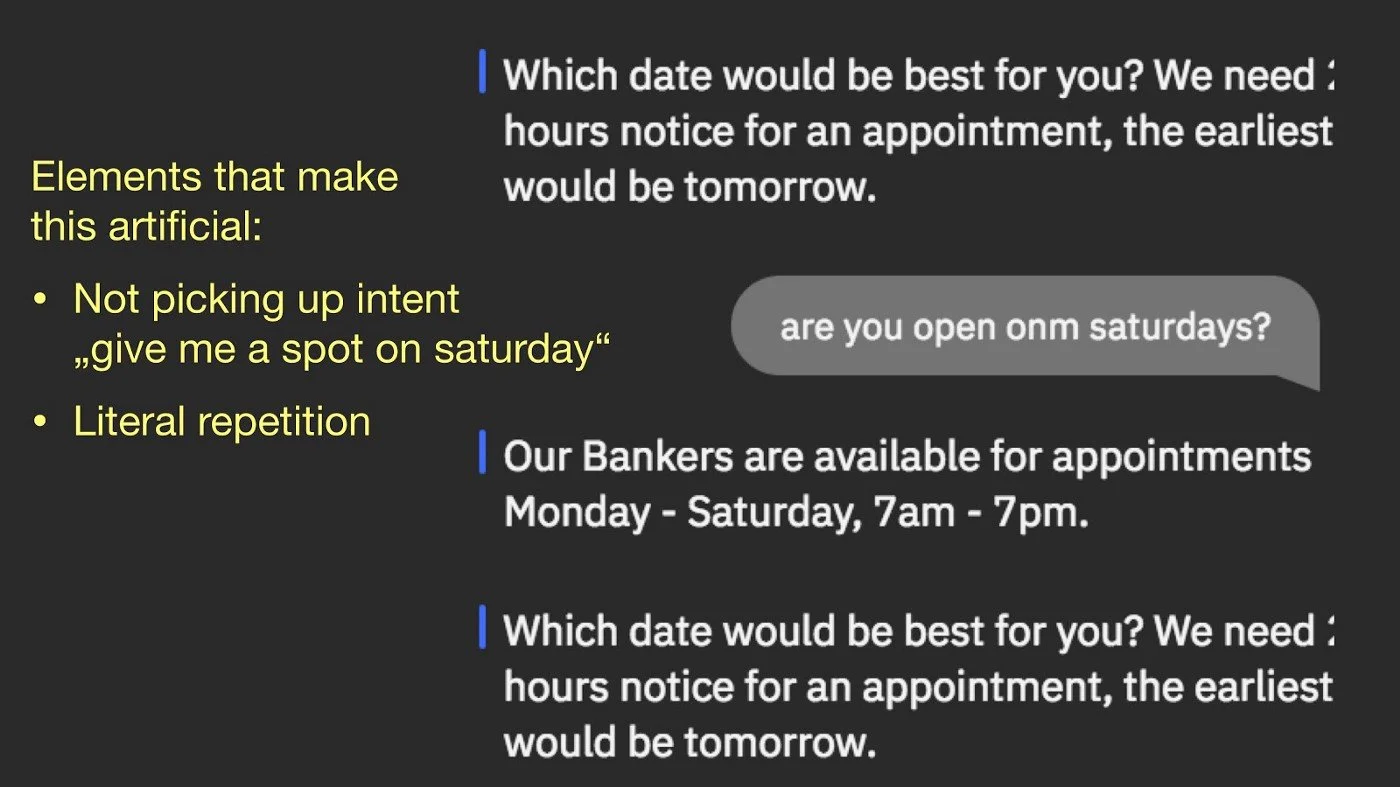
Artificial interactions are jarring for human participants. Slide © Memi Beltrame
Where designers can find their place in the arena of AI is in translating interactions to be more natural and reduce friction or weirdness when dealing with robots. The patterns of interactions can still feel like a like loop and unnatural.
Our work can focus on training the conversational UI to ease people’s fears when interacting with AI.
Another area designers can intervene within the field of AI is to propel forward questions of ethics. Beltrame’s message was similar to Cheryl Platz’s keynote in that engineers and others in tech are creating but without considering the implications of their decisions and inherent biases.
Training ML with edge cases enables the program to recognize what does not match “the norm”. This itself is problematic because so much of the training is done from an anglophone perspective, not even just that of Western Europe.
When systems are designed with only anglophone needs considered, the rest of the world then becomes an “edge case”.
Download Beltrame’s excellent slides here. They’re chockful of useful information and easily digestible. Plus, they also made me appreciate the typeface Georgia again.
Watch the video here on Vimeo.
From Design to Large-Scale Execution: Reshaping a Territory
Speaker: Sylvie Daumal, WeDigitalGarden — @Lyoko4TW
What if you arrived at 10:00am in a ski resort in the French Alps, lugging all your equipment but you couldn’t check into your lodge until 5:00pm and no other place in the town would let you store your stuff?
Sylvie Daumal presented a case study of service design implemented by her design firm, WeDigitalGarden, and they tried to solve just this problem. Their focus was to help a ski town that had a problem accommodating patrons who arrive into town at 10:00am on the only bus with their equipment and luggage. Adding to the problem was none of the lodges would allow luggage storage before check-in and restaurant owners in town turned away people as well. Imagine being stranded in the middle of town with all your heavy equipment and it’s snowing!
To top it all off, because of its mountain terrain, to access different sections of town, people had to take underground tunnels and elevators to walk to different areas. This was a classic case of different players saying “Not my problem” and not acquiescing to address the problems their patrons were facing.

– photo credit WeDigital.Garden
The design team spent 3 months doing design sprints on the project, alternating between on-site design workshops/user research and in-office iterating. They would spend one week in the local ski resort town iterating and working with varied stakeholders or testing ideas with the public. Stakeholders ranged from local ski lodge owners to the police department, planning commission and the transportation department. The other three weeks of a month were spent back in their office prototyping and iterating on possible ideas to debut in town.
Their prototyping involved signage for the underground tunnel and elevator; potential bus routes on the busses; a live Wizard of Oz prototype in a public square advertising a service where skiers could rent a locker and use showers before checking into lodges, and much more. All the tests exceeded expectations of the design team as well as the government and private sector stakeholders. It helped break down the barriers to collaboration that previously existed in the town by allowing them to see how much better an experience their town could give its patrons.
The results of having two designers is not 2 times better but rather 4 times better. — Sylvie Daumal
The biggest takeaway from this session is: Always have a team of at least 2 UX designers because most forms of research tasks take at least two minds. Whether that’s interviews, workshops, etc. The results of having two designers is not 2 times better but rather 4 times better.
Another important point is that most people confuse experience with quality of service. Simply because the service is seemingly polite (or impolite) does not mean the experience itself was worth having or could not be improved.
WeDigital.Garden published the full case study about the project here.
Sharpening Our Research Craft
Speakers: Jessica Dilworth— @1essDilworth and Ben Cubbon — @B_Cubbon of OVO Energy
Medical, scientific or sociology researchers have likely learned how to gather data without getting in the way of the subject but UX designers and researchers may still be in the nascent stage of data gathering. This possibly applies to the scores of UX designers (including myself) who were not specifically trained in rigorous data collection in degree programs or job roles.
Research craft = a process or body of repeatable set methods of collecting and analyzing data. In most cases, I would call this a toolkit or toolbox that each person may hone according to the needs of their project and the way they themselves process information.
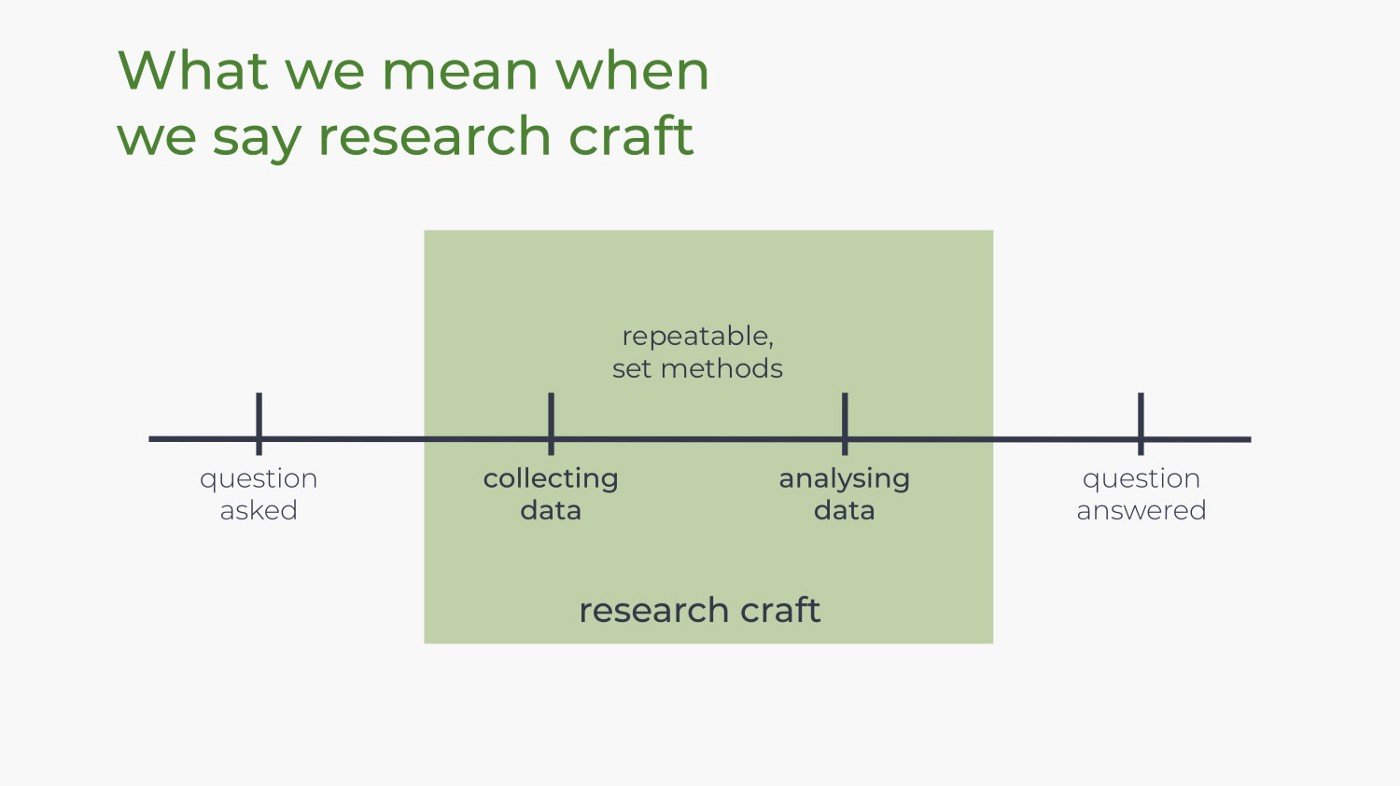
Research craft is process of collecting and analyzing data. Slide © OVO Energy design.
Research critiques were initially started by Jessica Dilworth and her critique was the first on their team. What prompted her to ask for critique was a user research phone interview session that didn’t go particularly well, with the participant being closed off. She had her colleagues listen to her interview and give feedback on her interview technique.
Via this critique session, she discovered that a speech habit where she would immediately say “Yeah” after receiving information from an interviewee. She unconsciously did this as a way to signal that she was receiving the information but it had the unintended effect of creating a bias for interviewees.
The interviewees would take this to mean a form of approval and to continue along a particular path or narrative that either wasn’t exactly conveying what the user experienced or it would shut down the conversation.
Have a basic structure when critiquing the research gathering process whether for a group critique or doing it along by yourself. Ground rules help keep the critique session on track while providing a sense of guidance for the end goals. That said, let it organically develop to give people space to create meaningful critique that can be taken and used later.
They shared a good resource for prompts for the research critique sessions to get you started — bit.ly/OVO_crit_prompts. You can also download their slides here & watch their video here.
I’ll definitely be looking to integrate this more in my next set of research on projects.
Put on Your Own Oxygen Mask Before Helping Others
Speaker: Anne Dhir, We Are Snook Ltd — @brightkaos
“We can’t design future experiences at the cost of present ones.” — Anne Dhir
Some projects centered around traumatic issues can be also be traumatic or triggering for the actual design and project team depending on their own personal experiences.
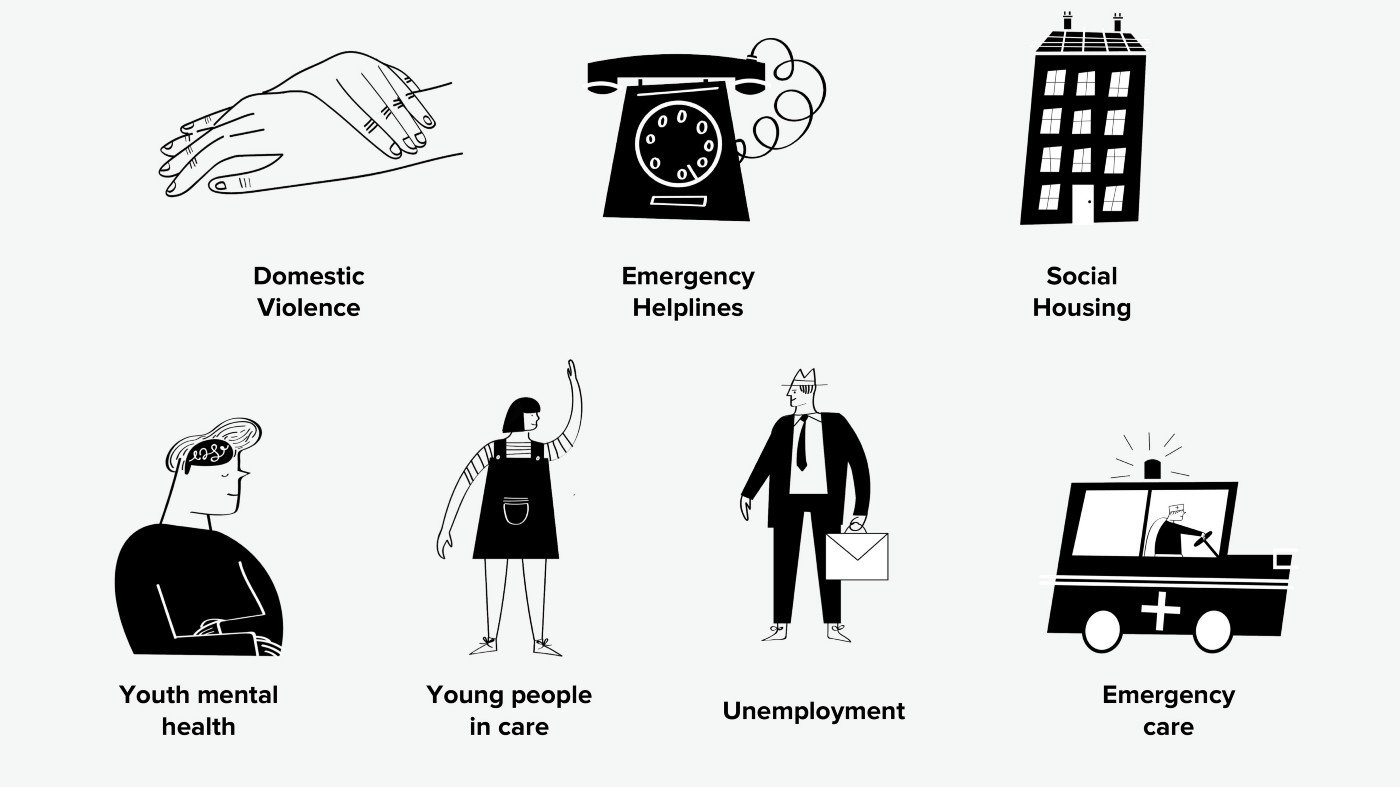
The research subject matters which may affect the mental health of your project team. Silde © We are Snook
Dhir’s thesis of her session was care for the team means care for the design project and research participants on the whole. It’s key to support your team that has to experience trauma either first or secondhand when working on projects. For example when working with populations experiencing domestic violence, police violence, housing or food insecurity, etc. — there can be an emotional distress experienced by the design or project team itself.
Guilt can also be a form of emotional distress that can take its toll. The team has no ability to directly influence the lives and problems of the interviewees such as complaining about government services like housing lotteries, etc. This does not prevent research participants from focusing their complaints, ire or sadness towards the researchers. The experience itself can be a distressing situation for the research team with a sense of helplessness but it’s up to the management and team to arm themselves to digest the content, process it and relay it back to the rest of the project team.
Jenga of Mental Health
A structure based on self-care becomes the foundation for mitigating the effects of difficult project subjects . Team members can do this by being aware of their strengths and limits and management being responsive to individuals’ needs. Weave empathy into the team and project management process in order to do good work and be present for the whole process.
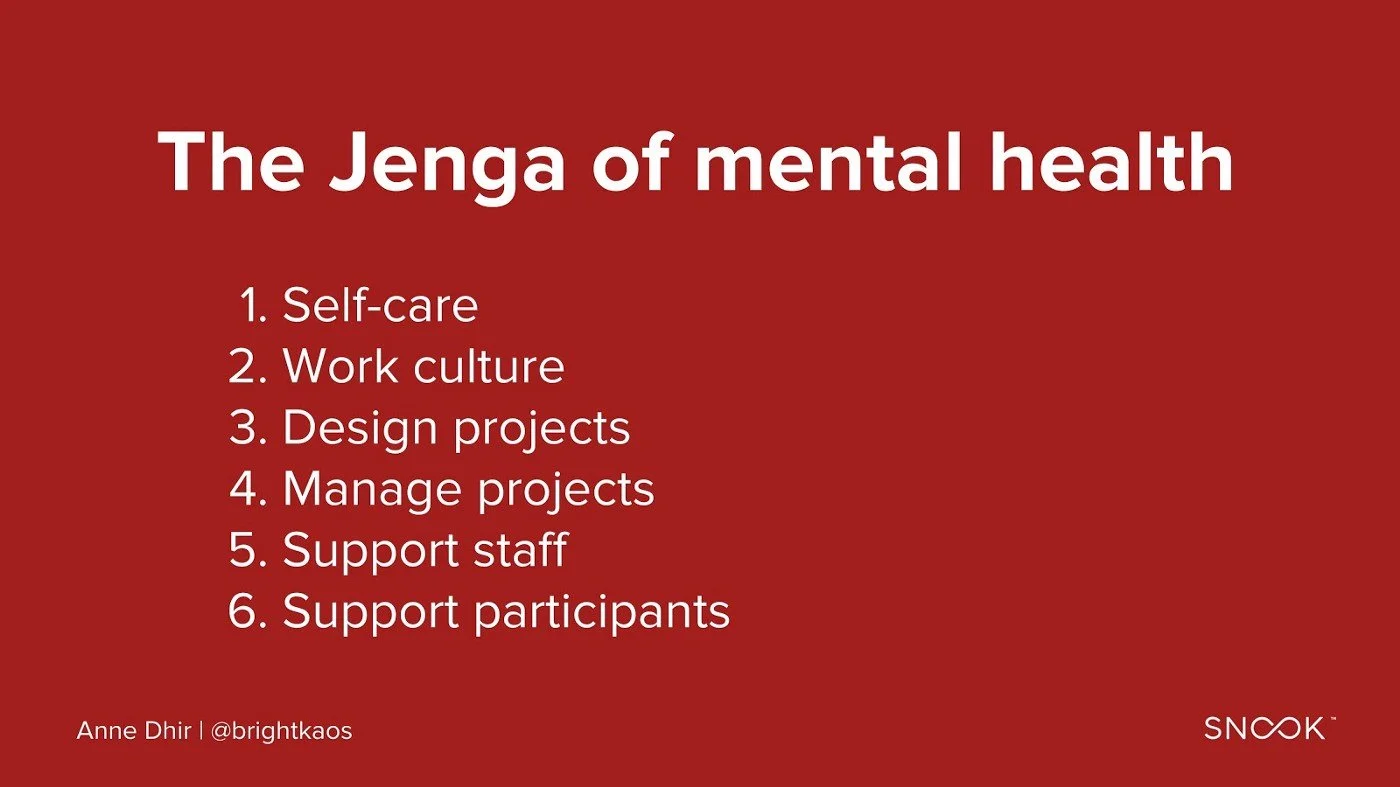
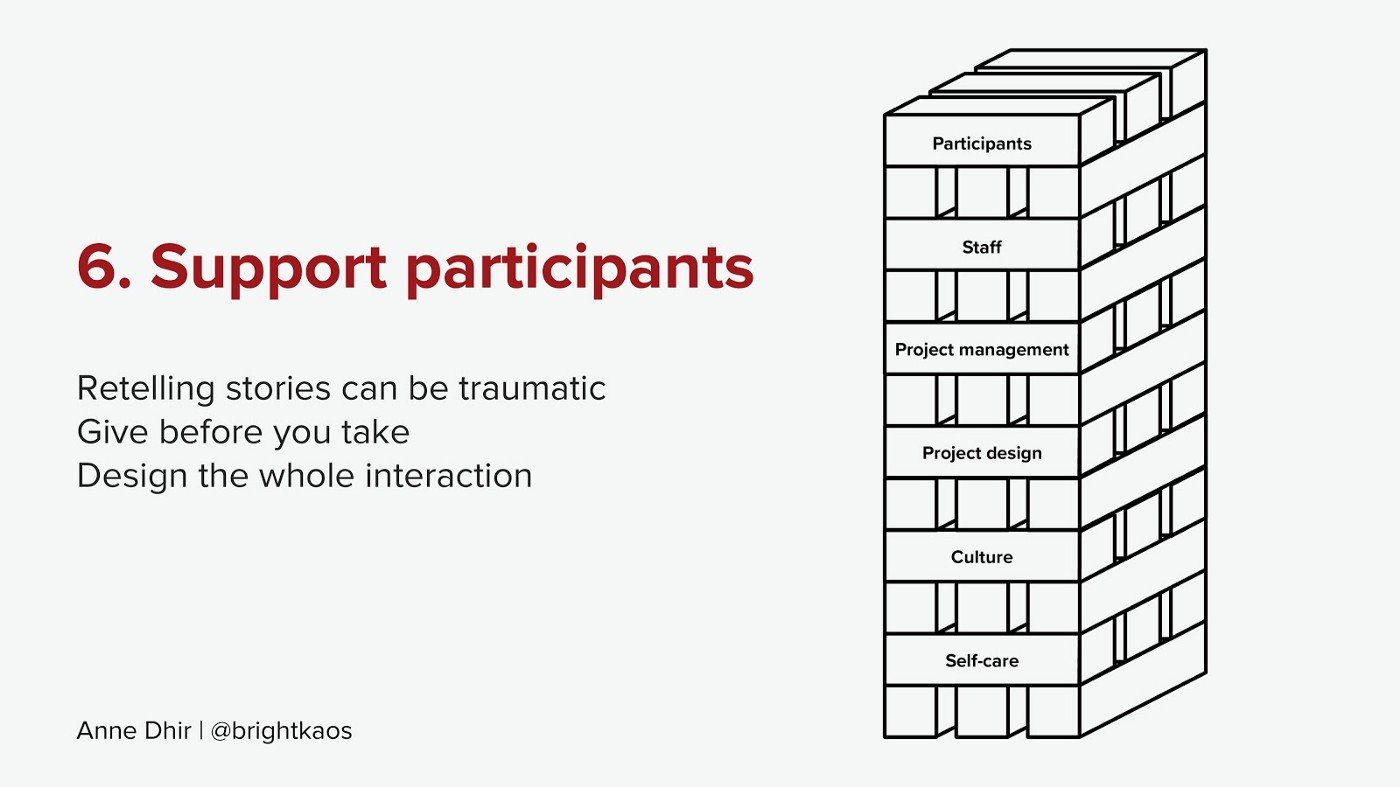
Only then do we arrive at the last step of the Jenga puzzle on top: the actual support of participants in the project.
See all the slides here to see the outlines of each Jenga piece.
Read their white paper that dives deeper into well-being management in service design: http://bit.ly/mentalhealthdesign.
Conclusion – Well, that was lovely.
It’s been a long time since I’ve attended a design or even specifically a UX conference. The last conference I attended was the 2018 KIKK Festival in Namur, Belgium and before that was Reasons.to Brighton in 2017. It was time to get some fresh blood in my veins.
My main reasons for attending UX Scotland varied:
Re-find my people. Or at least one kind of my people, anyway. I’ve been working with a lot of non-UX people lately and want to re-immerse myself in the industry to cut through to the salient points being discussed.
Update industry knowledge. There’s been a lot of UX chatter in the last couple of years with a chunk of it sounding like noise. My goal is to catch the useful parts and use those as a springboard for more intense learning.
Acquaint myself with the UX field and community in Scotland. I’m moving over here blind and want to understand what moves the practitioners in this part of the world. Doing so will help me discover the most effective ways I can contribute to the discussion. I’m especially looking to connect with senior level practitioners who are facing similar issues. It would be nice to support other UX folks and to find a like-minded group to bounce ideas around.
UX Scotland overall lived up to my expectations in terms of subject matter and the people attending. It wasn’t trend heavy and stuck to core issues currently facing practitioners and subjects in service design. Everyone I saw present or I chatted with was focused on learning and there were no big egos, which is refreshing. I also noticed there were lots of repeat attendees returning for 3 or even 5 years in a row. Based on that alone, I highly recommend attending if you have a chance.

Share your serotonin. What kept you going through 2021?
Happy new year! What happened with you and what did you discover last year? Here are three activities that carried me through 2021.

Pictured above: Doors on Newbattle Terrace, Edinburgh, Scotland. June 2021. View the full photo on Instagram.
Hi there.
Happy new year. We made it, most of us. I can’t believe we had to collectively pour one out for the inestimable Ms. Betty White on the last day of 2021. That had me tearing up for real, I’m not going to lie. Nonetheless, she would have wanted us to live our hearts out.
Last year was one of stretching for me. One of the big mind shifts I had was to simply experiment with different approaches, to well, everything. I tried various workshops and courses, took up some exercise, pushed myself career-wise, moved country, bought a house, and climbed a few (Scottish) hills.
What happened with you and what did you discover last year? Below are three activities that carried me through 2021.
What Kept You Going Through 2021?
The Writers' Hour

Can I tell you how wonderful this is? You're on this call with 100 – 200 other writers (and non-writers) of every single stripe working on their day to day work as well as their passions. There are people writing novels, academic papers, manifestos, the whole lot and it is absolutely inspiring to be one body together writing and supporting each other. They start each session out with a quote from a writer to inspire you and get your mind turning.
Sprung out of the London Writers' Salon during the 2020 lockdown, the Writers' Hour is a free virtual, hour-long writing sprint held each weekday, 4 times a day. They run 8:00am sessions in 4 different time zones: London, NYC, Los Angeles, and Sydney, Australia. Some days I tune in multiple times depending on what I want to knock out for the day.
Some people are working on their poetry before running off to their jobs as lawyers. I tend to work on journal pages or planning my to do list for the week. Other times I work on things like proposals or UX reports, so honestly it doesn't matter what you're writing as long as you write and think. And be nice to yourself. On one of my first sessions, I even spotted someone in her cute little writing shed with the requisite writer's cat walking all over her desk! Please check it out if you can.

Focusmate is online virtual coworking. If you missed people over the last year, this helped dramatically when not being able to head to coworking spaces. Choose a time slot, start a video session, and knock your tasks off your list. These could be client work, house decluttering, exercise, academic research or homework, you name it. The base service is free for 3 sessions per week and a meagre $5/month for unlimited sessions each month. Sessions come in 50 minutes or pomodoro friendly 25 minute sessions.
Focusmate helped me concentrate and work through tasks while also having the fun unexpected aspect of being able to "travel" during the past year by talking to new people around the world. I've co-worked with people in Illinois, California, Latvia, Australia, India, Hong Kong, Poland, Sri Lanka, South Africa, UK, Ireland, France, Jordan, and my good old New York City as well. I've even formed a wonderful art buddy relationship with a lovely woman named in Doris in western Germany. Which leads me to the last but not least…
Making Art Again

"Unknown Place" Risoprint
Finding those two prior resources led to me developing an art making habit once again. I can even say that I'm beginning to have a practice once more. My approach last year was to try anything even though I may be scared. One of my blockers about making art again was the feeling I had somehow lost my conceptual mojo and the ability to put complex ideas together via a visual medium.
The irony behind this of course is that whenever I was teaching UX courses, I drove home the point to my students that drawing is thinking, it’s processing and by the act of making, we were refining our ideas. It’s difficult to take your own advice, huh? Remembering that as someone who tends to learn by doing, with a bit of handholding, I sought out short courses that could chip away at the anxiety and artist block I've had for years. With the help of my new friend, Doris, I played a lot last year and will continue to experiment.
Last year I took a risoprinting workshop and produced a small set of posters. More about my experiment process in next month’s newsletter.
Risograph printing is a technique best described as 'digital screen printing'. The process is similar to screen printing, but with the convenience of an office copier. It's known for its vivid colours (that other printers can't produce) and its specific textures. – Definition by Risopop

Untitled Monoprint
In the small Scottish town where I now knock about, I’ve discovered a very inexpensive print studio. There are several print presses along with a UV exposure unit which means I can try out screen printing and cyanotypes. This came in handy when I took an online monoprinting course which led me to print on a press for the first time in 20 years.
Early in December I tried my hand at cyanotypes again, after another 20 year hiatus, and am going to continue playing and refining my ideas and process. Next up this month is a Modern Sketchbook online course at the 92nd Street Y that I’ll use to create a more formal art practice and making marks on paper/surfaces. Join it with me!
So, tell me, what got you through 2021? Was it a particular course, routine, people, place you loved or discovered? I’m genuinely interested because I want to let more good things into my periphery this year. Just hit reply to this email and let me know.
A Fun Thing
Seeing as how we're all paranoid now about colds versus Covid this winter, at least have a laugh, and take care. Link: https://xkcd.com/2535

Peace for now…
Y’all know the drill. This year I’m trying to show up more and connect with people more. So, please do schedule some time in my calendar for a call or virtual hot beverage or wine.
Go find me around the web as well:
Website | LinkedIn | Medium | Twitter | Instagram
Have a good week y'all,
Tricia